
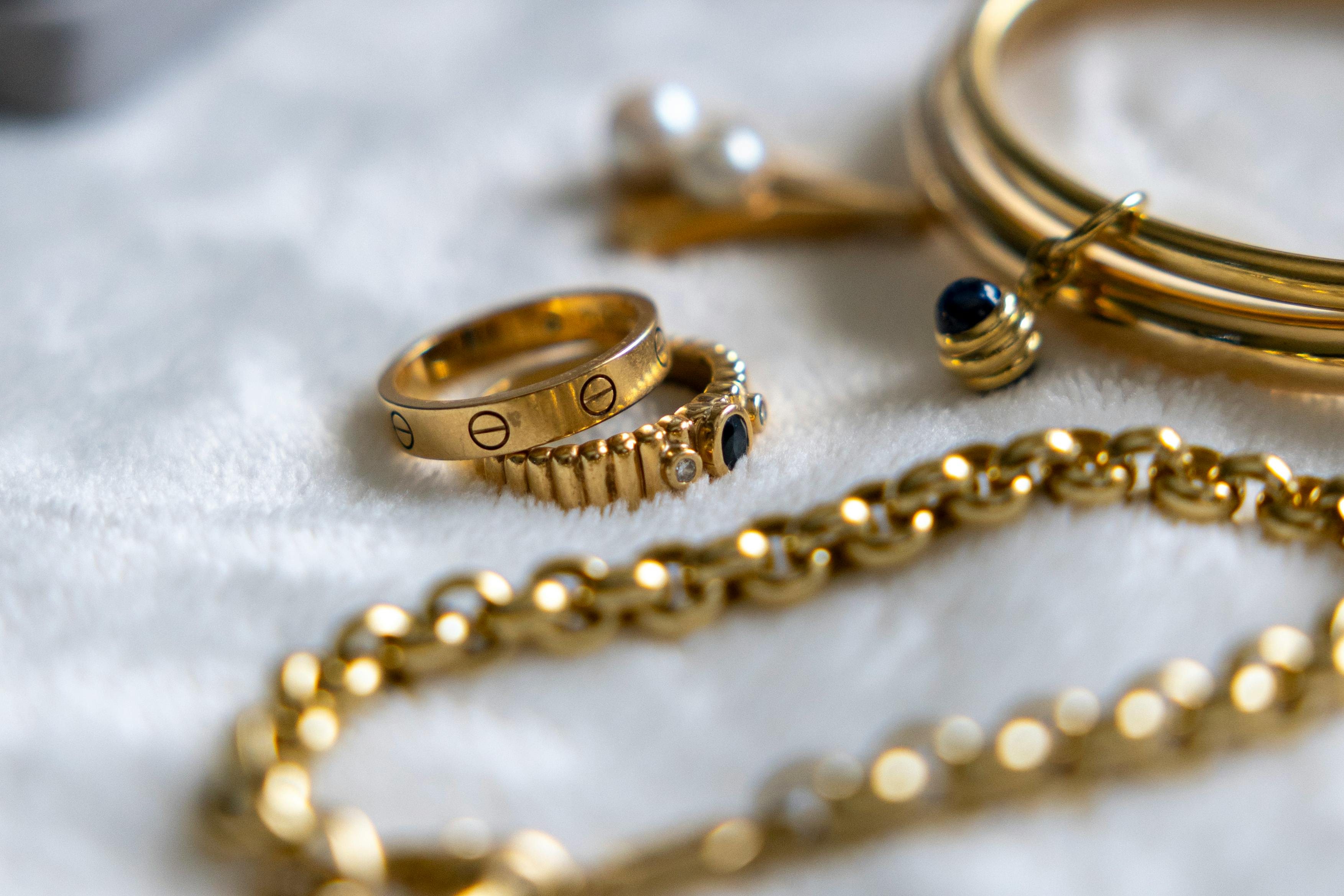
Gold Stamps - What do they mean?
Have you found small stamps on your jewelry and wonder what they mean? Stamps are the gold's 'ID card' and can tell you everything from who made the jewelry to how high the gold purity is. Understanding stamps is the key to knowing what your jewelry is worth.
Common purity stamps for gold and silver
The purity stamp is the most important stamp for value. It indicates how many thousandths of the metal is pure gold (or silver).
Gold stamps:
• 750: Means 75% pure gold – same as 18K. The most common stamp for fine jewelry in Sweden.
• 585: Means 58.5% pure gold – that is 14K. Standard in e.g. the USA and Eastern Europe.
• 375: Means 37.5% pure gold – 9K. Common in British and modern budget jewelry.
• 999 / 999.9: Almost 100% pure gold (24K), found on bars and investment coins.
Silver stamps:
• 925: Sterling silver, 92.5% silver. The most common stamp for jewelry and modern cutlery.
• 830: Working silver (83%), a common older Scandinavian standard.
• 800: Older European silver standard (80%), found on German and Continental pieces.
Platinum stamps:
• 950: High-purity platinum (95%), the standard stamp for fine platinum jewelry.
• Pt or Plat: Also used to indicate platinum.
Control stamps and the Cat's Paw
In Sweden, since the 16th century, there has been a tradition of state control of precious metals. The most famous Swedish control stamp is the 'Kattfoten' (The Cat's Paw) – a three-lobed stamp that was applied by the Gold- and Silversmiths' Guild in Stockholm or one of the regional assay offices. If your jewelry has the cat's paw, it is a guarantee that the silver or gold content has been verified and certified under Swedish law.
From 1912 to 1970, a system of letter and number combinations was used to indicate the assay office and year. Since 1970, hallmarking is often voluntary, and modern Swedish jewelry may sometimes lack control stamps without this affecting quality.
Maker and year stamps
In addition to the purity stamp and the cat's paw, Swedish jewelry often has a maker's stamp (for example, initials in a cartouche, such as 'GAB' for Guldsmedsaktiebolaget) and a year stamp. The Swedish year stamp system is unique: a letter is combined with a number to encode a specific year. For example, 'P10' can correspond to the year 1989.
This is fascinating for antique enthusiasts, but ultimately it is the purity stamp (e.g. 750 or 585) that determines the metal value of the jewelry. Maker stamps can sometimes increase antique value if it concerns a known goldsmith, but this is not factored into a standard scrap valuation.
Can't find any stamps?
No worries! Jewelry can be unstamped or the stamps may have worn off. We always test your gold with advanced XRF technology to see exactly what it contains. Sell safely to us.